Published
April 1, 2026
"Seizing Opportunities: Spotable’s Journey from Ghent to the US Market"

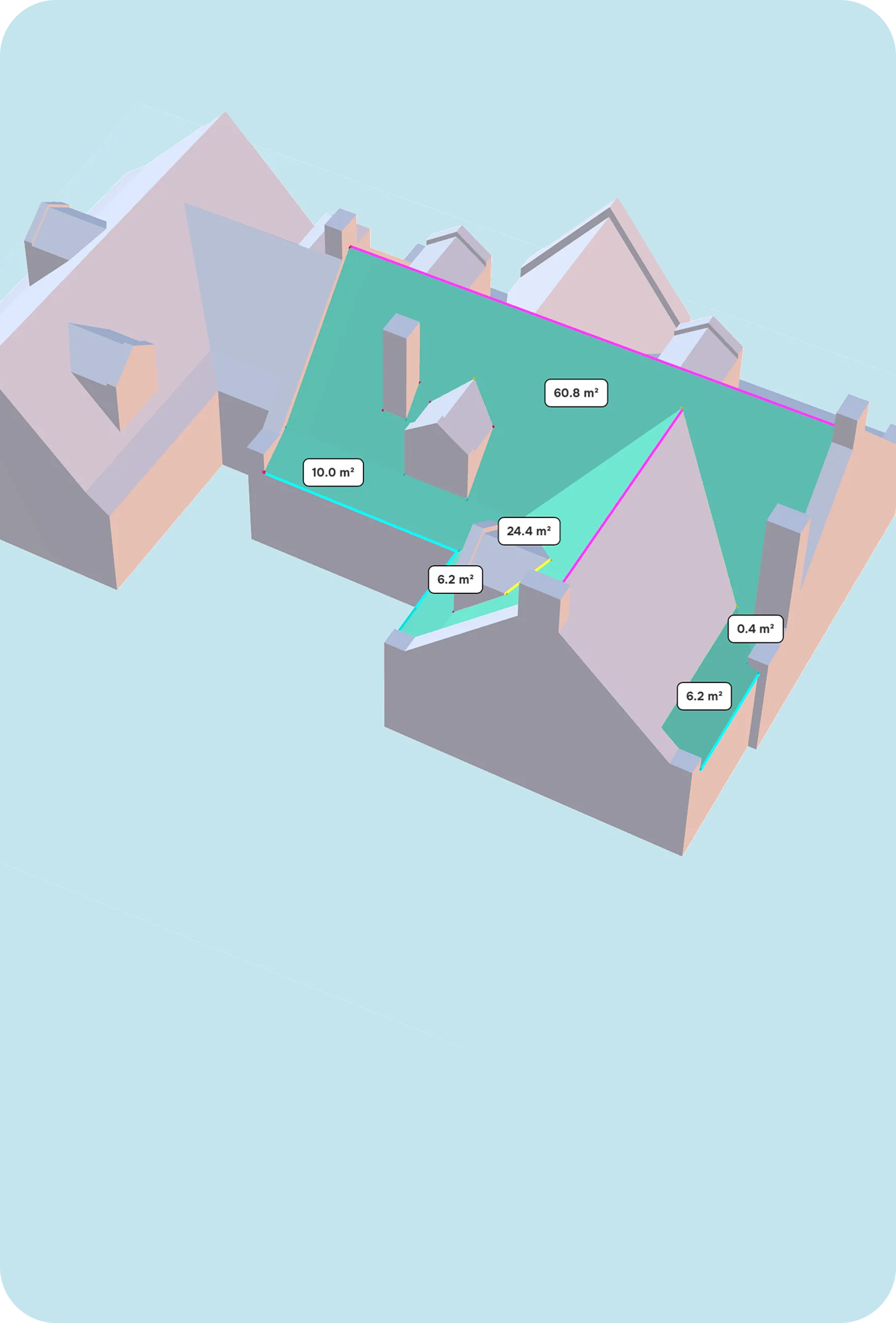
In just one year, the Ghent-based construction tech startup Spotable has navigated growth phases that would make many founders envious. Their software allows contractors to generate accurate 3D measurements of roofs and facades in just a few clicks. During their pre-seed round, a small team laid the foundations for product development, validation, scalability, sales, and international expansion. Co-founder and CRO Julie Duloulin brings her experience and strategic vision to a startup betting big on AI, data, and product-led growth.
Once an entrepreneur...
Entrepreneurship runs through Julie's veins. With an academic background in business economics, she started her professional career at a marketing and strategy agency: "After six months, I already had my own client portfolio," Julie explains. "This led me to start giving workshops as a side business on data and trend analysis, as well as marketing and business strategies."
The arrival of COVID-19 inspired Julie to return to university. During her postgraduate studies, she developed an idea for a startup focused on the predictability of marketing campaign success. This eventually led to a collaboration with an Antwerp-based SME. "I was CEO for two years, but I noticed the entrepreneur in me starting to resurface," she laughs. "I was itching to sink my teeth into a startup again. That’s how I eventually became the third co-founder at Spotable."
A rollercoaster
Spotable has had an impressive year. One Julie describes as a true rollercoaster. "Normally, you start with a pre-seed round to develop and validate a first product, followed by a seed round. At Spotable, we actually completed all the components of a seed round during our pre-seed phase."
"With our idea, we hit the nail on the head immediately," Julie continues. "But the execution was a different story. We completely restarted our coding while raising the pre-seed round in the first quarter and building a team. During that process, we prepped our sales structure and our product for further growth."
With international expansion in mind, Spotable simultaneously built a global data system. Quite a challenge, according to Julie: "People often don't realize the complexity behind the software. While an international module offers us many advantages, it makes little difference to the customer. Sometimes our investors urged us to move faster, but for us, it was a crucial step to safeguard our future growth."
Across the ocean
According to Julie, Spotable is currently looking at the U.S. market as a new and highly interesting player. "European investors advised us to move to the United States. The market there is larger, more mature, and the momentum is undeniable." "In Europe, everyone talks about AI, but sales conversations are still primarily educational. The 'what’s in it for you' mindset is central here. In the U.S., people are already convinced. When you can apply product-led sales in that market, the world opens up at a rapid pace."
Nevertheless, Spotable remains cautious in its U.S. expansion. Before taking the plunge, the company wants to validate and experiment for a year. "Investors often tell us this isn't the right approach and that we should just take the bull by the horns and establish ourselves in the States immediately. But when you know how expensive it is, it's better to take it slow and be certain it will work. That’s why we’ve chosen a slightly slower but well-thought-out approach."
Despite this, Spotable has successfully launched products there. "Even with heavy competition, we can sell more easily in the U.S. than in Belgium," Julie says. "Americans are very direct. There is a lot of interest in us, even from our competitors. They even drop by and ask us bluntly what our goal is. The competitive culture there is vastly different from the European one."
Teams and traction
This year, Spotable is aiming for two million euros in funding, fully supported by existing investors. Julie highlights two success factors from previous rounds that they will apply again this year: "Your team is an essential factor in funding rounds," she begins. "Many teams fail because their profiles or skills don't align. Investors know your product or sales process will change ten times. They are looking for a team that is in sync, can handle change, and is ready to make quick decisions."
"At Spotable, we complement each other very well. We consciously chose three co-founders because we need to upscale quickly. When you enter the tech scene and work with external capital, you know you have to at least decuple that amount within a few years. That’s a huge responsibility you shouldn’t carry alone."
The second success factor: traction. "It remains important to highlight your milestones and ambition. Experiment enough and hit the right KPIs. When you see opportunities, you have to seize them as much as possible."
Sales makes the difference
"Sales always comes first. You can have a great product, but if you can't sell it, it’s worth nothing," Julie says. "Vary your approach and look for ways to improve. In a world where software can be replicated in no time using AI and LLMs, you can only stay ahead of the competition through your distribution. That has never been more important than it is today. Our focus isn't just on building software; it’s about ensuring Spotable continues to stand out in the future,"


Other
Press Releases
The latest industry news, interviews, technologies, and resources.